



 Polska
 Deutschland
 France
 Romania
 Česká republika
 Italia
 España





Responsibility shows in the details nobody usually shows you
It's easy to write "we care about the environment" and leave it at that. We prefer to show the specifics. Every parcel leaving Poniatów is protected with paper filler, not bubble wrap. For most formats we have dedicated boxes that protect delicate paper without a gram of plastic.
We sort all warehouse waste; offcuts from paper trimming have their own stream and go back to recycling. Sales documents are generated and sent digitally, so the invoice lands in your inbox, not on a printout.
All of this is a standard for us, not a campaign. We don't turn it into a big marketing stunt, because we treat it as a given for a responsible company that has grown over more than a decade from 100 to nearly 4,000 m² of warehouse space.
But there's a second layer where we truly stand out, and one that few in the industry can match. It's the papers themselves: collections made from post-consumer recycling, agri-food waste and rapidly renewable raw materials. We write about them further down.
Six things we do in the warehouse – every day, without fanfare
This is what caring for the environment looks like in practice for a paper distributor. Not a one-season campaign, but the way we run our warehouse in Poniatów every day.
Eco-friendly filling
To protect shipments we use paper filler, not bubble wrap, and we try to seal parcels with paper tape rather than plastic. For most formats we have dedicated boxes that protect the paper without plastic.
Waste sorting
We responsibly sort all warehouse waste so that as much as possible goes to recycling. Paper offcuts from trimming have their own stream.
Cutting to size
On request we cut paper exactly to the size of your project. Instead of buying a whole A3 sheet and throwing half away, you get only what you'll use, and we send the trimming waste to recycling.
Buying in small quantities
You can buy envelopes even individually, paper from 10 sheets, and handmade paper from just 5. You order a sample instead of a whole pack "just in case", so less paper ages and goes to waste.
Paperless documents
We generate and send sales documents digitally. The invoice lands in your inbox, not on a printout, unless you specifically need a paper version.
European raw material
We buy our key collections directly from manufacturers in Europe, with a shorter supply chain and consistent, controlled fibre quality.
We sort because we run real waste management
Environmental responsibility also means formal obligations. We keep records and hand waste over to authorised operators, in line with regulations, not just on paper.
And now the best part – papers that are sustainability in themselves
Responsible packaging and waste sorting are offered by many today. What few can match is the composition of the paper itself. At Netuno you'll find the widest shelf in Poland of collections made from post-consumer recycling, agri-food waste and rapidly renewable raw materials, with verifiable fibre origin, not an "eco" label tacked onto the description.
Crush – paper made from fruit, vegetable and nut residues
The flagship eco collection of the Italian paper mill Favini. Instead of ending up as compost, food-processing waste returns to circulation as a full-value premium paper. The formula took 18 months to develop and the process is patented in Europe.
Paper that turns into flowers after use
This is a paper of an entirely different kind: handmade paper with embedded seeds. Flowers, herbs or vegetables trapped in the structure of the sheet. An invitation, business card or tag does its job and then goes not into the bin, but into the ground.
You lay the sheet flat on the soil, cover it with a thin layer of earth and water it. The cellulose breaks down and the seeds sprout evenly. It's the most literal form of zero waste in paper – a carrier of information gets a third life as a plant.
- Tear the sheet up and lay it on moist soil in a pot.
- Cover with a thin layer of soil and water generously.
- Place in a warm, bright spot and keep it moist.
Where we source our paper
We buy our key collections directly from European paper mills that manage their raw materials responsibly and hold certificates confirming that the fibre comes from sustainably managed forests. Below we show what sets each of them apart. Hard proof – certificate numbers and links to registries – we provide on request, including in tender procedures.
Crush
Paper containing fibre from agri-food waste and recycled fibre, supplemented with certified virgin pulp. Made in Italy on renewable energy from the mill's own hydroelectric plant, GMO-free.
Materica
Paper containing recycled fibre and cotton, with a pronounced texture you can feel with your fingers. Chlorine-free (ECF) bleached, acid-free, free of heavy metals. Raw material from responsibly managed forests.
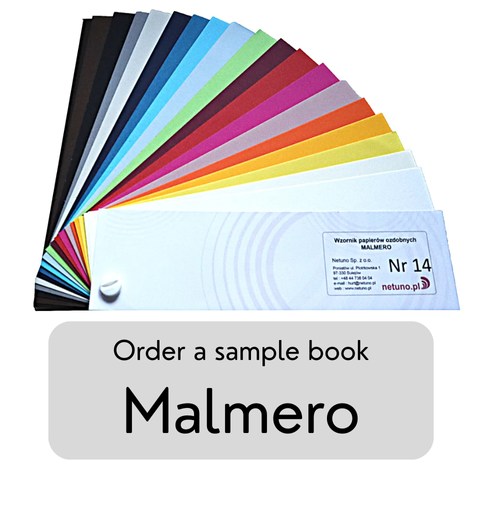
Malmero
Pulp-dyed paper made from virgin pulp, chlorine-free (ECF) bleached, from responsibly managed forests. It contains no recycled fibre but is itself fully recyclable, free of heavy metals.
You'll find the full specification and documents confirming raw-material origin for each collection on the product page, and we also provide them directly on request.
Not sure which eco paper suits your project?
Call and talk to a person who knows every one of these collections by name. We'll tell you whether your invitation is better suited to raw Eco Kraft, elegant Crush made from fruit residues or seed paper, and we'll send a sample before you order the whole batch.
